



What is the Ford EcoBoost Engine?
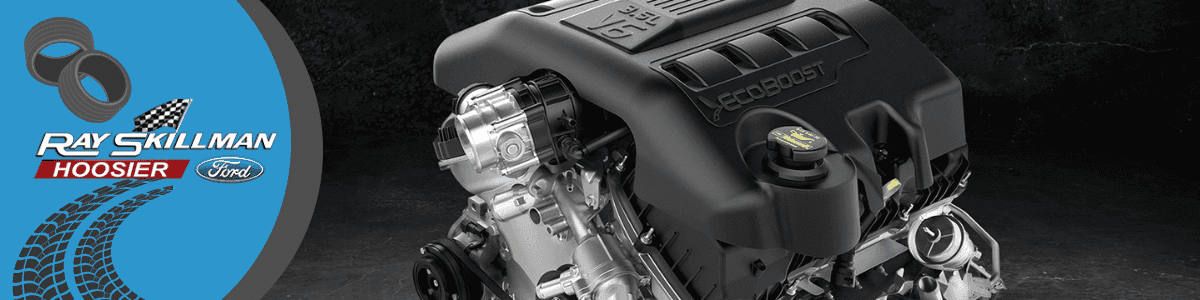
A Quick Guide to the EcoBoost Engine Lineup
Ford built the EcoBoost name around one idea: smaller engines that hit hard. Through turbocharging, direct fuel injection, and twin independent variable camshaft timing, these motors give drivers the muscle of a bigger engine while sipping less gas. You’ll find the Ford EcoBoost engine in everything from the Mustang to the F-150, the Bronco to the Explorer.
- The EcoBoost family includes a 2.3L four-cylinder plus 2.7L, 3.0L, and 3.5L V6 options.
- Each version blends turbo boost with direct injection for stronger output and respectable MPG.
- You’ll spot these engines across the Ford truck and SUV lineup, from the Mustang to the F-150 Raptor.
How the Ford EcoBoost Engine Works
Three pieces of tech work together to make EcoBoost tick. A turbocharger forces more air into the cylinders, direct injection sprays fuel right where it’s needed, and twin independent variable camshaft timing keeps the valves dialed in across the rev range. That combo lets a smaller engine punch above its weight while using less gas than a comparable naturally aspirated motor.
Since 2009, Ford has rolled out EcoBoost across most of its truck and SUV lineup. Smaller versions feel lively off the line because boost arrives early in the rev range, while V6 variants can pull heavy trailers without a thirsty V8.
The 2.3L Ford Mustang EcoBoost
Four-cylinder turbo power lives in the 2.3L. In the 2026 Mustang EcoBoost Fastback, it makes 315 horsepower and 350 lb-ft of torque, paired with a 10-speed automatic. Run zero to sixty in around 4.5 seconds while still pulling 22 city and 33 highway mpg.
You’ll also find this engine in the Bronco, where it makes 275 hp on regular gas and 300 hp on premium. The Ford Mustang EcoBoost has become a fan favorite for buyers who want sports car looks and turbo punch without the V8 fuel bill.
Stepping up to the Ford 2.7 EcoBoost V6
Pick the Ford 2.7 EcoBoost twin-turbo V6 and you get 325 horsepower with 400 lb-ft of torque in the F-150. It’s the standard engine on the F-150 XL, STX, and XLT trims, and it can tow up to 8,400 pounds when properly equipped. A tuned version lives under the Bronco’s hood too, producing 315 to 330 horsepower depending on fuel grade. Ford engineers nicknamed this V6 “Nano” for its compact size, and the small footprint hides surprising power.
The Ford 3.5 EcoBoost V6
Heavy hitter time. The Ford 3.5 EcoBoost puts out 382 hp and 500 lb-ft of torque in the standard F-150, with a max tow rating of 13,500 pounds when fitted with the Max Trailer Tow Package. Move up to the F-150 Raptor and the high-output version of the same engine cranks up to 450 horsepower and 510 lb-ft.
This same family of engines also powers the Expedition full-size SUV. It pairs with an electric motor in the F-150 PowerBoost full hybrid, where the truck can act as a backup generator thanks to its 7.2-kilowatt Pro Power Onboard system.
Ford EcoBoost Engine Comparison
| EcoBoost Engine | Horsepower | Torque | Common Ford Models | Max Tow Rating |
|---|---|---|---|---|
| 2.3L EcoBoost I-4 | 315 hp (Mustang) | 350 lb-ft | Mustang, Bronco, Ranger, Explorer | 7,500 lbs (Ranger) |
| 2.7L EcoBoost V6 | 325 hp (F-150) | 400 lb-ft | F-150, Bronco, Ranger | 8,400 lbs (F-150) |
| 3.0L EcoBoost V6 | 418 hp (Bronco Raptor) | 440 lb-ft | Bronco Raptor, Explorer ST | 4,500 lbs (Bronco) |
| 3.5L EcoBoost V6 | 382 hp std / 450 hp HO | 500 lb-ft std / 510 lb-ft HO | F-150, F-150 Raptor, Expedition | 13,500 lbs (F-150) |
Ford EcoBoost Frequently Asked Questions
Is the Ford EcoBoost engine reliable?
Yes, when you stay on top of basic maintenance. Stick to the recommended oil change interval, use the right grade of fuel, and watch for any leaks or check engine lights. These turbo motors have been in production for over 15 years, and Ford has had time to sort out the early growing pains.
Does an EcoBoost engine require premium fuel?
Most EcoBoost engines run fine on 87-octane regular gas. The Bronco and a few performance trims make more horsepower on 91-octane premium, but you won’t damage anything by running the lower grade. Always check the owner’s manual for your model.
Can the F-150 EcoBoost tow a camper?
Absolutely. The Ford F-150 Ecoboost lineup tows from 8,400 pounds with the 2.7L up to 13,500 pounds with the properly equipped 3.5L. That covers everything from a small travel trailer to a sizable fifth-wheel.
How does EcoBoost fuel economy compare to a V8?
EcoBoost engines usually return better MPG than a comparable V8, especially in highway driving. The 2.3L Mustang EcoBoost gets up to 33 mpg highway compared to 24 for the 5.0L Coyote V8 in the GT.
Picking the Right Turbo for Your Driving Habits
Choosing between the four EcoBoost options comes down to what you tow and how much power you want. Daily drivers tend to love the 2.3L and 2.7L for their everyday feel and friendlier fuel bills. Anyone hauling boats or heavy payloads usually leans toward the 3.5L. Either way, an EcoBoost badge means modern turbo power that stretches a tank further than a big V8.
Test Drive the Ford EcoBoost Lineup at Ray Skillman Hoosier Ford
Whether you’re shopping for a Mustang EcoBoost Fastback, an F-150 with the 2.7L or 3.5L V6, a Bronco for weekend trails, or an Explorer for family hauls, we have the Ford EcoBoost lineup ready for back-to-back test drives. Stop by Ray Skillman Hoosier Ford, and our team will walk you through which engine fits the way you drive. We’ve been Martinsville’s hometown Ford store for years, and our factory-trained service techs know these turbo motors inside and out.
0 comment(s) so far on What is the Ford EcoBoost Engine?